Our Mission
Our charitable purpose has two strands, and we treat them as inseparable: education — passing on Ki Aikido in its complete form — and community benefit — making sure that education reaches people who would otherwise never have access to it.
Education. We provide a structured, authentic path for developing mind-body coordination: practical methods for managing stress, building genuine confidence, and reaching a calm, focused state of mind that carries into daily life. We teach it in weekly classes, publish it in writing free to read, and preserve it exactly as it was developed and passed down to us.
Community benefit. The challenges this practice addresses — stress, lost focus, the physical cost of sedentary work — are not confined to people who can afford a martial art. So we run the dojo as a public service rather than a business: the first class is free, fees are reduced for anyone facing financial hardship, and nobody is turned away for lack of means.
Our Values
- Authenticity — We teach Ki Aikido in its complete and original form, as developed by Master Koichi Tohei. We do not adapt or simplify the art for commercial purposes.
- Inclusivity — Ki Aikido is for everyone. Age, fitness level, background, and experience are not barriers. We welcome all communities, including Māori and Pacific peoples, and extend a particular invitation to those who have never considered a martial art before.
- Personal Growth — There is no competition in Ki Aikido. Progress is measured against your own potential, not against others. Every student evolves at their own pace, in a supportive and non-competitive environment.
Who We Serve
Our beneficiary is the general public of Aotearoa New Zealand. In practice, that means the people who walk through the door are rarely the ones a martial art usually reaches:
- People with no martial arts background — most of our students have never trained in one, and had assumed it was not for them.
- Adults carrying the cost of sedentary work — stress, poor posture, shallow breathing, a mind that will not settle at the end of the day.
- Older beginners — there is no upper age limit here, and no competitive bracket to age out of. Our scheduled classes are adult classes, from 15 up; families with younger practitioners should write to us and we'll find the right option.
- Māori and Pacific communities — historically under-served by Auckland's martial arts and wellbeing provision, and explicitly invited here.
- People for whom cost is the barrier — fees are reduced on the basis of need, and nobody is turned away for lack of means.
What We Provide Free of Charge
A charitable purpose is only real if it survives contact with someone who cannot pay. These are the commitments we hold ourselves to:
- A free first class, always — no obligation, no sign-up, no commitment to continue.
- Need-based fee reductions — financial circumstances should never decide who gets to practise. Ask us privately; the conversation stays between us.
- Free public demonstrations and community events — open to anyone, whether or not they ever train with us.
- Written instruction, published openly — our articles and etiquette guide are free to read, with no account and no newsletter wall.
- Support for new dojo communities — if a community elsewhere in New Zealand wants to study this art, write to us. We will help you start.
Our Story
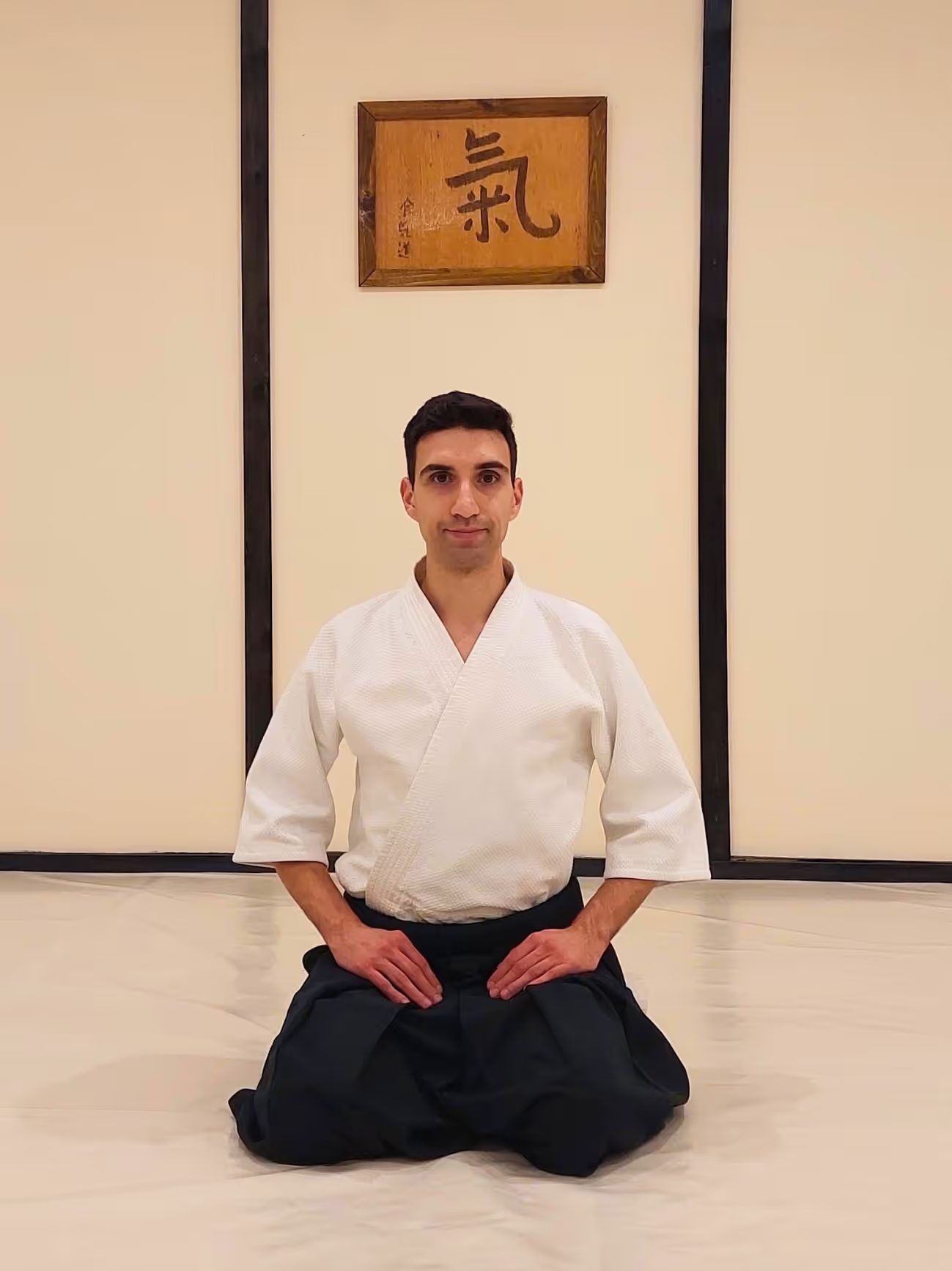
Ki Aikido arrived in New Zealand through one instructor's commitment to sharing what he had spent over fifteen years studying and teaching.
Cristian Filimon Sensei began his Ki Aikido journey in 2009 in Romania, under the guidance of Sensei Mihai Dulgeru and The Association of Ki and Aikido Romania. By 2017, he had begun teaching — and over the following years developed a deep understanding of how this art transforms people's lives, not just on the mat, but in how they think, move, and respond to the world around them.
In 2025, Filimon Sensei (4th Dan) relocated to New Zealand, and in 2026 he founded The Association of Ki and Aikido.


Why New Zealand
New Zealand is a country that values authenticity, community, and wellbeing. It is also a country where stress, burnout, and the search for meaningful practice are very real experiences for many people.
Ki Aikido offers something rare — a practice that is simultaneously ancient and immediately practical. Rooted in Japanese tradition, it addresses challenges that are universally human. Auckland, as the country's most diverse and dynamic city, is the natural starting point for building a Ki Aikido community that reflects the full breadth of New Zealand society.
Our vision is to grow beyond Auckland — establishing dojo communities in Wellington, Christchurch, and beyond — making Ki Aikido a practice available to all New Zealanders who seek it.
Our aim is to establish a dojo in any city or community across New Zealand. If you are part of a community and would like to study this art, please don't hesitate to reach out to us at [email protected].
Our Nonprofit Status
We are not a martial arts business. The Association of Ki and Aikido has no owners and no shareholders, distributes no profit, and holds every dollar it receives for its charitable purpose. Member contributions cover the cost of running weekly classes — hall hire, mats, insurance — and anything beyond that goes back into fee reductions, free community sessions, and reaching parts of New Zealand that have no dojo.
The trust is registered with Charities Services under registration number CC64768.
Governance and Accountability
Every fact below is public, and can be checked against the official registers:
- Legal structure — a charitable trust board incorporated under the Charitable Trusts Act, Companies Office number 50252386.
- Charity registration — registered with Charities Services on 10 February 2026, registration number CC64768.
- Governance — the trust is governed under its trust deed; Cristian Filimon is the Chairperson.
- Reporting — the financial year ends on 31 March, and the trust files an annual return with Charities Services, which publishes it on the register.
- Funding — member contributions and voluntary donations. There is no commercial income.
If you would like to support our mission, you can make a voluntary donation.